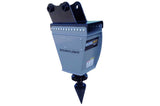
The RSX780 splits wood by boring a spiral cone into the end of a log rather than pushing a wedge through it with a cylinder. The cone threads itself in and the timber opens along its own grain, so there is no ram stroke to wait on between splits and nothing to reset before the next one; the supplier's own comparison is the plain one, much higher splitting force than a cylinder splitter working at the same pressure. It takes stems up to 12 ft, and by the supplier's account as long as 20 ft, and works them horizontally or vertically where they already lie.
This is not the smaller excavator machine with a bigger cone on it. Where the 380 and 580 run a gear-type drive on a hex shaft, the 780 runs a piston motor behind its planetary drive and carries the cone on a heavy duty 8-bolt flange bit holder instead, and its own chart is a different chart from theirs: torque holds constant as flow rises and the speed climbs with it, which is the signature of a fixed displacement motor turning slowly and pulling hard. The lowest torque anywhere on that chart is more than twice the highest figure on the chart the smaller machines share, and a pressure gauge on the head lets the operator watch the work load rather than infer it.
The same drive takes a stump planer bit, and that is a different job rather than a variation on the first one. Where the splitter opens a log, the planer takes a stump out of the ground, and the supplier's case for it is speed rather than force: it turns at a low RPM, so the chips stay where they fall instead of being thrown, which is what makes it usable on a front lawn or in a confined space where containing the mess matters as much as removing the stump. Because it is not trying to reduce wood to fine material the way a high speed cutting wheel does, it asks less power for the same stump, and that is what lets a smaller carrier take on a bigger one. What it leaves behind is coarse chip rather than dust, which the supplier points out is mulch for other plantings instead of spoil to haul away.
The bit is built to be maintained rather than consumed. A hardened entry tip starts the cut and unbolts when it is worn, the same replaceable-tip idea the splitting cone uses, and above it sit two grades of blade doing two jobs: a smaller leading blade in AR500 steel that takes the first cut, and a larger clean up blade in AR400 that follows it. All of the cutting blades can be sharpened, which is the supplier's argument for the running cost, that blades are resharpened rather than replaced as often. Both tools bolt to the same 8-bolt flange, and the supplier prices each of them as an option against this one machine.
What the excavator version buys is reach, and on this model it is reach with a large carrier under it. The head hangs off an arm and works a pile from one setup, and because the cone can be bored part way into a log and left there, one operator can lift a stem and place it without leaving the cab. The tool you pick under Tool is included in the price, whether that is the complete 8-bolt flange mount 14x8 splitter cone assembly D003935, the 8-bolt flange mount stump planer bit D003381, or both of them; so is the excavator-side blank weld-on plate D001419 that the Mount Option choice carries. That leaves two things to arrange before it can run, because the RSX models ship without hoses and the flow band is worth confirming, so check what the head will actually see before matching it to a high flow carrier.
Common Applications
- Removing a tree stump by planing it down to grade, leaving coarse chip rather than fine spoil
- Stump removal in urban areas and confined spaces, where the low cutting speed keeps chips contained
- Splitting felled timber into firewood on site
- Processing storm and clearing wood without moving every log to a landing
- Land clearing work where felled stems are cut down before removal
- Splitting oversized rounds a cylinder splitter stalls on
- Picking up and repositioning a stem by boring part way into it, without leaving the cab
Selection Notes
- The Tool choice is a real decision and the three values are not degrees of one thing. The splitter cone assembly D003935 is the log-splitting tool; the stump planer bit D003381 is the stump-removal tool; the third value supplies both, so the machine changes over in the field. The tool you choose is supplied with the machine.
- On this model the planer bit costs slightly more than the splitting cone, 1,348.00 against 1,332.00 at the supplier's own list. That is the reverse of the 380 and 580, where the planer bit is the cheaper of the two tools.
- The recommended carrier weight differs by tool: 18 ton maximum with the splitter cone fitted and 15 ton maximum with the stump planer tool. Both are close to double the 580's figures, so this head needs a much larger excavator under it. A buyer taking both tools should size the carrier to the lower of the two figures, because the machine has to suit whichever tool is on it.
- The excavator mount is not one part. The head carries a bolt-on adaptor so it can be moved between machines, and the excavator-side blank weld-on plate is the piece that gets welded to the carrier's own stick or coupler. This model's connection code is A03, which the supplier pairs with D001419, a blank plate for 8 to 25 ton excavators, a different plate from the one the two smaller excavator models take, and that is the plate the Mount Option choice supplies. Its bolt set D004952 runs to twenty-six bolts against the smaller plate's ten, and is supplied with the mount when the mount is ordered with the machine.
- Only the blank weld-on plate is supplied with this machine. A buyer running a quick coupler orders the coupler adaptor through the supplier's turn-key excavator adaptor program, which the supplier prices by carrier ton class rather than by attachment.
- The cone is an 8 Bolt Flange drive. The cone assembly itself is not interchangeable with the 2 in Hex used on the 380 and 580, but two wear parts are shared across both drive sizes: the hardened entry tip D002506 and the upper cone half D003722.
- The piston motor and the flange bit holder are what this model buys over the hex-drive machines. Choose it for torque and carrier size, not for reach or speed.
- Hoses are not included with the RSX models and are ordered separately. They are included with the RSS skid steer models.
- A case drain is the fitment item to settle first, and it is not optional on this machine in normal use. The supplier calls it good to have under 3,000 PSI and a must at 3,000 PSI and over, and this model's recommended pressure band runs to 4,500 PSI with a 5,000 PSI maximum.
- Confirm the recommended flow band and the maximum before matching the head to a high flow carrier.